Author: Gaunt Francis Architects

National Christmas Jumper Day 2015

christmastreeFriday 18th December 2015 was the evening of the Gaunt Francis Christmas Party, and as if that wasn’t enough festive cheer, it was also National Christmas Jumper Day.

We were motivated to don our festive apparel by the ‘Text Santa’ charity appeal, which, like a Christmas version of Comic Relief, enables people to make donations to worthy causes through fundraising, one-off donations and taking part in a nationally televised event.

We are proud to have raised over £100 this year by wearing our Christmas jumpers, eating mince pies and spiced biscuits, and taking part in sweepstakes! The money raised will be split between three charities; Macmillan (whom we fundraised for earlier this year with our GFA Macmillan Coffee Morning), Make-A-Wish UK, who grant wishes to children fighting life-threatening conditions, and Save the Children, who provide for children and young people in war-torn and impoverished countries.


QDocWVeQICK9uXYvsG3sLgwpgrbkdJ5xlK3aw_8aojY

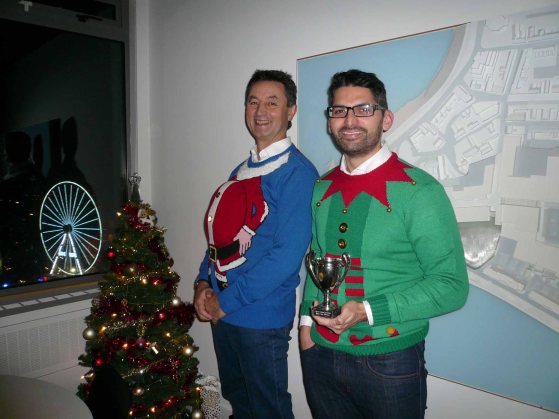
Of course, we had a best jumper competition, the winner of which would take the Gaunt Francis Architects Social Event Champion’s Trophy from Toby, who won it at the bowls social back in September. It was a very close score, with only one point between first and second place! Second place went to Alan, who sported a fetching jumper complete with padded Santa’s belly, but first place went very deservedly to Adam, whose jumper gave him the body of an elf, complete with bells and stripy socks!

jumperwinnners.JPG

Winner Adam with the GFA trophy and second place, Alan.

A huge thanks goes to our social secretary, Mike,  for organising the event and also to everyone who took part, did their bit in their festive knit, provided Christmas treats, and donated money to these important causes. We were delighted to get involved, as it is the season of goodwill after all and we had a wonderful time and a lot of laughs fundraising for ‘Text Santa’ this Christmas!

Christmasjumpers

Here we are, resplendent in our festive attire!

Eco-housing Part 2- The Barratt Green House

In 2007, Gaunt Francis entered and won the Home for the Future competition with their design for the Green House. It won with over 22,000 votes not just because it was zero carbon rated, but precisely because of its elegant and homely design which was missing from so many other attempts at creating eco-housing.

CGIHouseView-creditGlassCanvas

Gaunt Francis Architects’ winning design for the Barratt Green House at BRE

Built by Barratt Homes at the Building Research Establishment (BRE), the Green House was the first zero carbon, Code Level 6 dwelling to be built by a volume house builder.

As we saw in our last blog post, the SOLCER House was the first carbon-positive house to ever be built. Parts of the house however, are still uninhabitable and though it was a successful experiment into carbon-positive structures, really, the Gaunt Francis design was the first realistic eco-house ever built in the UK, because of its aesthetic likeness to traditional housing. This house proves that in order to be ‘green’ or live a sustainable, renewable lifestyle, you don’t have to compromise on comfort, technology or style. Renewable and eco-friendly materials were used throughout the house, from low-emission paints and natural ink wallpapers, to natural organically certified materials like cotton, wool and silk for the carpets, mattresses and even the towels.

Through clever interior design, there is an astonishing level of recycled materials used in the Green House, for such an elegant, homely and stylish look. All wood used in the property is FSC certified and where possible, second-hand furniture has been ‘upcycled’ with high standard refurbishment, such as natural fabric upholstery. Not only this, but extensive use of recycled materials for decorative accessories, such as glass (in the chandeliers in the dining area), and plastics (using recycled yoghurt pots and milk cartons for media unit doors) helps the Green House to hit its renewable, carbon neutral targets.

greenhouse.jpg

Inside the Green House are all the familiar home comforts of traditional homes.


The Green House has a number of cutting edge technical features which help it to achieve such high levels of compliance with the regulations for zero-carbon certification, as shown in the annotated section below. Some of these include triple glazed windows, solar panels, rooftop bio-diverse vegetation and a futuristic, interactive computer control panel which regulates the heating and cooling of the house to ensure maximum precision in energy management.

SectionwithNotes-creditGauntFrancis-GlassCanvas.jpg

Some of the Green House’s eco-features.


The house is a 130m2 (1400 sq ft) three storey, three/four bedroom family home, including an open plan living, dining and kitchen space; downstairs cloakroom; games/play room; home office; family bathroom; and ensuite to the main bedroom of the three provided. All rooms are serviced from a central hallway, which starts from the front door and covered carport area and terminates at the second floor external terrace. The house was designed to be built as part of a row of terraced houses, which not only improves energy efficiency, but also so the house can be connected to a district electricity generating/heating system.

CGIStreetscape-creditGlassCanvas

A proposed row of Green Houses. In terms of efficiency, the Green House performs best when built as part of a zero-carbon community.


The whole purpose of the Green House was to see if zero-carbon housing could ever be achieved a) by a volume housebuilder, and b) whilst still being an attractive and inviting home. SOLCER House is great, but it’s not very cosy. Green House was designed in line with the 2006 UK government’s target for all new homes to be zero-carbon rated by 2016, and the long-term target of an 80% reduction in carbon emissions from homes by 2050. However, in the summer of 2015, these targets were axed by the Conservative government (in a movement which was widely criticised by environmentalists, architects and housebuilders alike). This was despite David Cameron touring the BRE Innovation Park in 2010, spending time in the Green House itself, where he heard about the key principals that underpin the delivery of more sustainable homes. Following the tour, the Prime Minister said;

“Looking at the houses here today, it is clear that people’s energy bills can come down if homes are properly insulated and properly built.”

This knowledge however, had been apparently forgotten, as the chancellor stated that the decision for scrapping the targets was based on the efforts to make housing less expensive and create a more prosperous nation.

SOLCER House and the Green House however, had already proved that positive-carbon dwellings were within the accepted budget for social housing. In a BBC report, John O’Brien, the Principal Consultant at BRE, said that the chancellor’s decision was “flawed” because it absolutely did not cost more to build zero carbon homes, and in fact, they could even provide an income or reduced energy expenses for owners, which the Prime Minister had already stated himself (as above). As well as resulting in greatly reduced energy bills, homes which produce their own energy can actually glean income from energy contributions to the national grid, producing a highly efficient system UK-wide, not only in just new-build housing areas. Still, regardless of this, the target slashing went ahead.

Today, the Green House is still part of the BRE Innovation Park, where you can visit and take tours of the Green House along with other sustainable dwelling prototypes. It’s an educational park where you can learn about the design, materials and technologies which make carbon-neutral building possible. Unfortunately, it doesn’t look as though we’ll be living in houses like this on a large scale for some time. Nevertheless, the Green House remains proof that eco-housing works and with the 2050 target fast approaching, sustainable houses such as SOLCER and the Green House will soon be highly in demand, and not long after, become essential.


Eco-Housing Part 1- SOLCER House

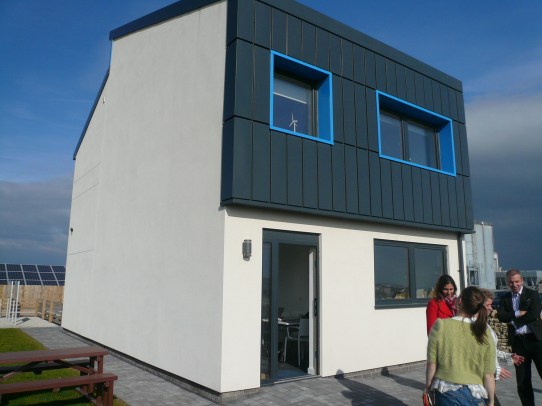
This is the SOLCER House; the UK’s first low cost, zero carbon, carbon positive house.

The SOLCER House

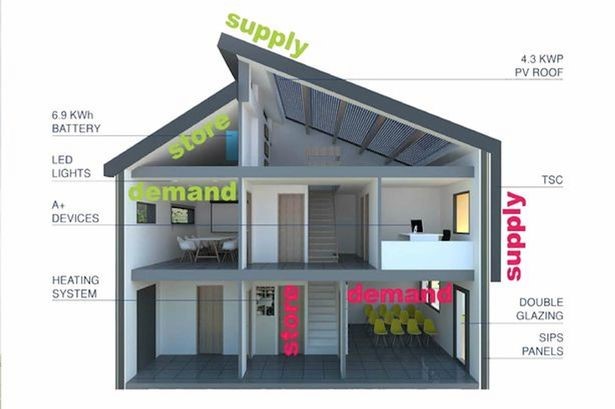
Designed by Professor Phil Jones and his team based at the Welsh School of Architecture, Cardiff University, the house was built in July 2015 as a ‘smart energy’ prototype in an astonishingly successful attempt to meet the tough targets for zero carbon housing set by the UK Government (now axed by George Osborne). The house, constructed as part of the Wales Low Carbon Research Institute’s (LCRI) SOLCER project, and supported by SPECIFIC at Swansea University, is low-cost, energy smart, and is capable of producing and exporting more energy to the national electricity grid than it uses.

Some of the features, allowing the house to be really smart with its energy production, storage and usage.

Professor Jones said of the design,

“The Welsh and UK Governments – and governments across the EU – have set targets for very low ‘nearly zero’ energy buildings by 2020, and zero carbon new housing can deliver this and more. This means that as an academic community we have to rise to that challenge and come-up with innovative new ways to build houses of the future.”

When the UK government’s eventual dismissal of these targets was announced, it attracted widespread criticism not only from environmentalists, but also from house builders, planners and universities. It would have ensured that all houses were carbon positive and making significant energy contributions to the grid by 2016.

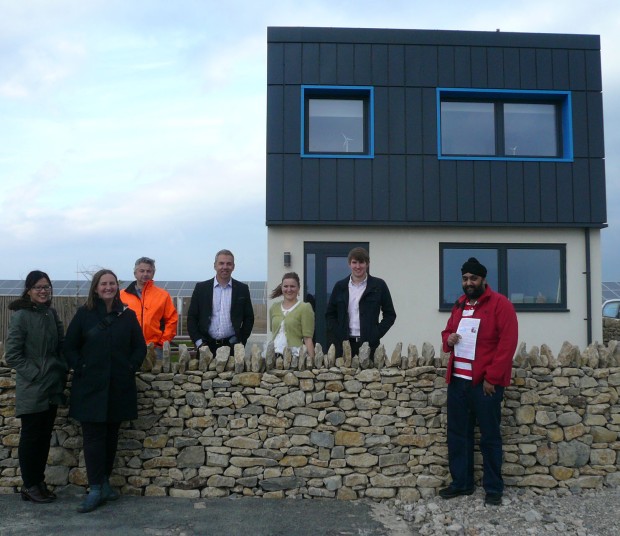
GFA at the SOLCER House

GFA at the SOLCER House

On Friday 16th November 2015, a few members of staff from GFA decided to make a trip to see it. I asked around the office to see what we learned:

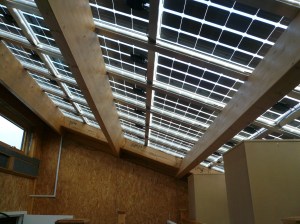
The loft space

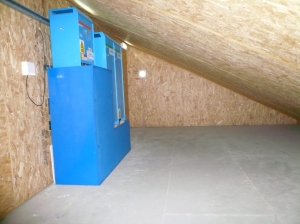
The loft space, which can currently not be lived in due to its lack of insulation.

Architectural Technologist, Miranda, said:

 “The most interesting part of the building from a design standpoint was the loft area, which is roofed in glass with PV panels attached, creating a striking, light-filled space. Unfortunately, without insulation, the space is not actually habitable. But the basic idea could be taken forward with some form of transparent insulation to create a very interesting architecture, which directly makes the eco-credentials of the building visible.”

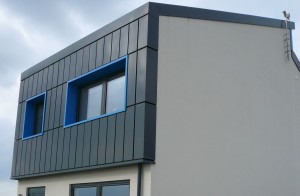
Transpired Solar Collector (TSC) Panels. They’re essentially sheets of metal that have a few tiny holes in and an air gap behind. When the sun hits the surface of the metal, the air behind it heats up. The system then moves this heated air around the house using the natural ventilation.

Transpired Solar Collector (TSC) Panels.
They’re essentially sheets of metal that have a few tiny holes in and an air gap behind. When the sun hits the surface of the metal, the air behind it heats up. The system then moves this heated air around the house.

Director and architect, Gavin, said:

“The external metal wall panels, TSC solar air collectors, were an interesting concept. It’s good to see more sustainable projects being built in Wales and congratulations to the WSA Architectural Science group on funding, designing and building an energy positive house. GFA have our low carbon batteries re-charged after the visit. The attic space was interesting in that the PV cells were mounted directly onto glazing; seems a shame that it wasn’t a habitable room but is a great concept for further development.”

The house, although being an incredible positive carbon model, is not the most aesthetically attractive home, making it unattractive to developers and housebuilders, despite all it's benefits.

The house, although being an incredible positive carbon model, is perhaps not the most aesthetically attractive home; will that make it unattractive to developers and housebuilders, despite all its benefits?

Architectural Assistant, Sam, said:

“It was quite inspiring to see a physical manifestation of what can actually be done with off the shelf materials to make a house environmentally friendly. It’s a shame that it hasn’t turned out to be the most attractive building. I think the next step for architects though is to use some of the techniques and systems cleverly to create an attractive (and potentially cheaper) architecture that developers will be more willing to get on board with.”

For a non-architect who doesn’t really know anything about the environmental aspects of designing a building, it’s really refreshing and encouraging to see that environmental concern and energy efficiency is at the forefront of research and practice in universities and in architectural studios. It’s continuing to be pioneered, despite there no longer being an immediate target, which is just as well really, as we need to be reaching an 80% reduction in carbon emissions from homes by 2050 under the Climate Change Act.

What Sam said was particularly interesting, because in 2007, Gaunt Francis entered and won the 2007 Home for the Future competition with their design for the Green House. It won with over 22,000 votes not just because it was zero carbon rated, but precisely because of its elegant and homely design which was missing from so many other attempts at creating eco-housing. The 2015 SOLCER House was successful as a technological experiment to see if a carbon positive dwelling was a possibility, but the Green House was the first zero carbon, Code Level 6 dwelling to be built by a volume house builder, Barratt, at the Building Research Establishment (BRE). Really, the Gaunt Francis design was the first realistic eco-house ever built in the UK, because of its attractiveness to ordinary people who want somewhere cosy to come home to at the end of the day (which makes it an attractive design for developers, too).

We’ll take a closer look at GFA’s Green House design and building, in next month’s blog posts. Perhaps the technology of the SOLCER House and the Green House design together, are an insight into the sustainable buildings of the very near future.

Macmillan Cancer Care Coffee Morning

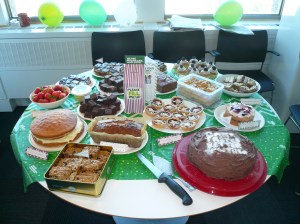
P1120428Could there be a better way of catching up, than over a piece of cake or seven, and a coffee? And since one in three of us will face cancer in our lifetimes, what better a cause to bake for than Macmillan Cancer Support. Friday 25th September was the 2015 date for the World’s Biggest Coffee Morning; it’s the annual day when people who want to support Macmillan come together and bake, eat, chat, eat, drink tea and eat to raise money to donate. All up and down the country, in offices, church halls, schools and community centres, people are baking, buying and eating cake to sell at bake sales and coffee mornings, and since we love our 11am tea break, we thought we’d get involved too!
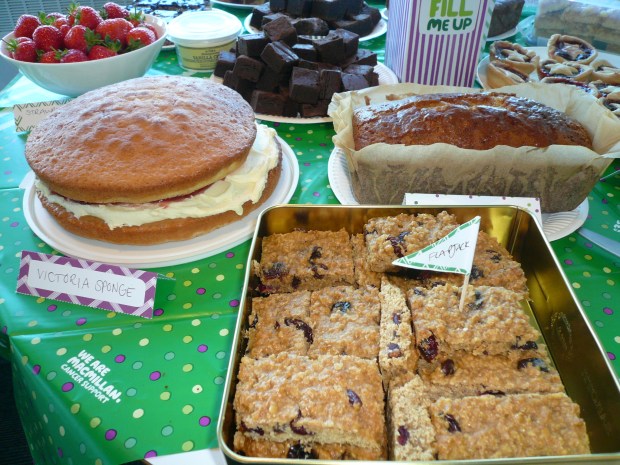
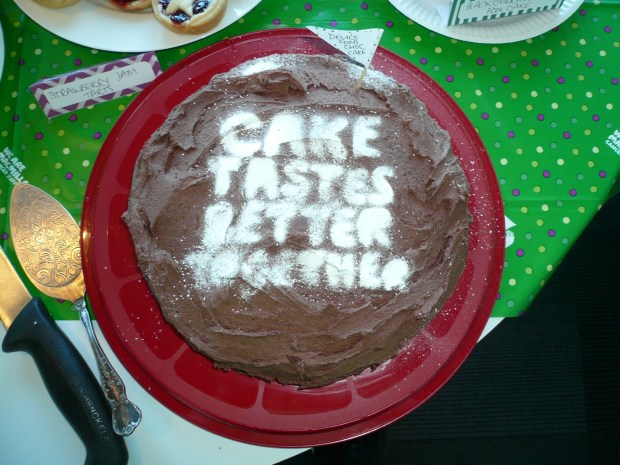
We started off by ordering the online pack which contained everything we needed to run our own morning, like a table cloth, posters, donation box and other lovely little bits and pieces, like little flags to label your baked goodies, a Macmillan stencil for your cake and a ‘Spot the Cake’ Sweepstake game.

After that, comes the baking. This is what we came up with!

A Victoria Sponge, fruity flapjacks, a lemon drizzle, brownies, strawberries and cream...

A Victoria Sponge, fruity flapjacks, a lemon drizzle, brownies, strawberries and cream…

Jam tarts, blackberry fool cake, Malteaser tiffin, almond and honey cakes, bara brith, Oreo cupcakes...

Jam tarts, blackberry fool cake, Malteaser tiffin, almond and honey cakes, Bara Brith, Oreo cupcakes, Donauwelle…

P1120430

And of course, a Chocolate Devil’s Food Cake!

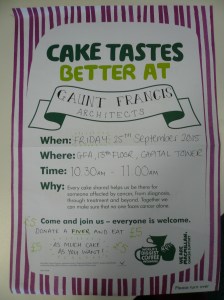
Our poster for the event!

Our poster for the event!

We invited people from all floors of our 23 storey building by posting little invitations and it was lovely to chat to our neighbours on different floors who we’d never met before when they came to donate and have some tea and cake. We suggested that everyone donated £5 and then could eat as much cake as they wanted/could, but everyone was very generous with what they put in the collection  box.

We raised over £130 for Macmillan and we’re still counting as donations continue to be collected from all over the building! At the time of writing, people have raised £867,563.33 for Macmillan altogether and Gaunt Francis are very proud to be a part of that.

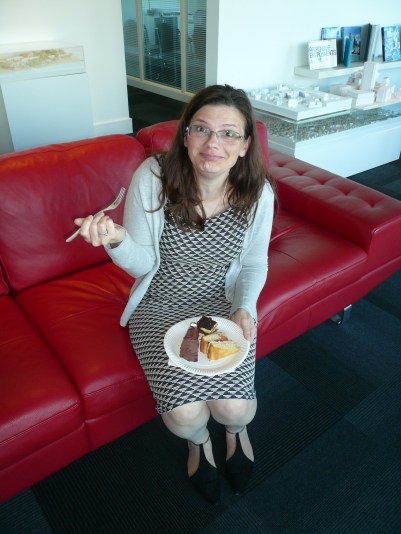
So a huge THANK YOU! to everyone who donated, baked, ate, chatted and came to the Macmillan Coffee Morning- your money goes a long way! A super special thank you to the organiser, Steph (pictured below tucking in to some well deserved cake!) and the biggest thank you of all to Macmillan Cancer Support, for continuing to provide valuable care for those affected by cancer and for making sure nobody faces cancer alone.

Our organiser, Steph, enjoying some of our best baking!

Our organiser, Steph, enjoying some of our best baking!

Staff Social- A Night at the Bowls!

Last Friday night, (18th September) the Gaunt Francis team decided we’d try our hand at Bowls. Mistakenly assumed to be a past-time only for the aged, we were surprised to discover that our very own social secretary, Mike, plays regularly, it’s a game suitable for all ages, and we were delighted to hear that he could teach us how to play. So, we gathered our waterproofs and headed to St. Fagan’s Bowls Club.

Bowls is a game suitable for the young and the aged! Oh...sorry Gavin!

Bowls is a game suitable for the young and the aged! Oh…sorry Gavin!

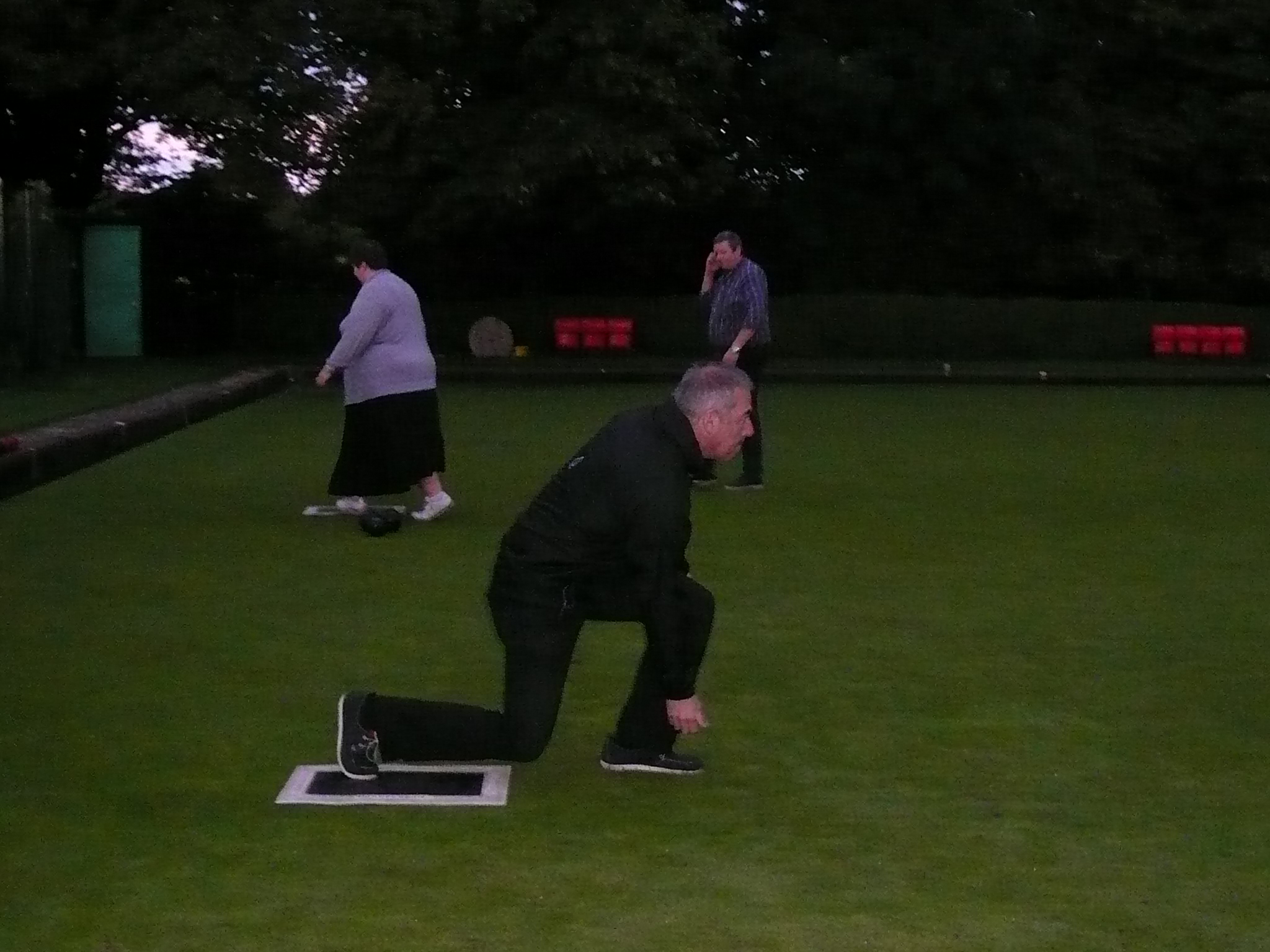
The evening was a lot of fun. We split into six teams of four, and played in group pairs against each other. The aim of the game is to get your team’s bowls as close to the jack (the white ball) as possible. Not only this, but each bowl is weighted, so that it curves in a particular direction. This meant that team tactics had to be strategised! Of course, barely any of these went to plan, and for some teams, game time consisted of apologising for barging into a neighbouring game when your bowl rolled wildly off course.

Whose bowl is whose? None of them appear to have been aimed at either white ball...!

Whose bowl is whose? None of them appear to have been aimed at either white ball…!

You can knock other players’ bowls out of the way with yours, or build a defensive line around the jack. You can curve your bowl around others to get closer to the target, or you can line up your next shot to block the way for the opposing team. Or you can do what we did- lob the bowl and hope for the best!

It’s not supposed to be a particularly physical game, so it was surprising to see the amount of dangerous-looking lunging going on!

Hmm.

Hmm.

P1120328

Trying to keep those toes on the mat!

Katja almost taking flight!

Katja almost taking flight!

Steady on.

Steady on, Gavin!

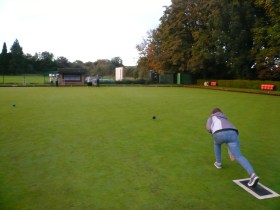
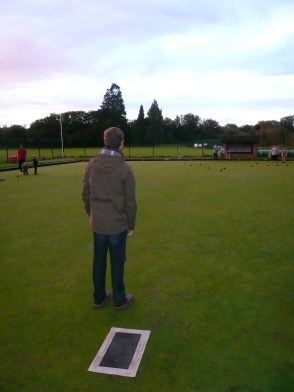
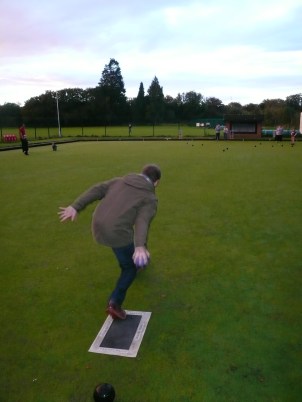
We also found that there was a very structured approach to playing, which involved bowling your bowl, and then standing motionless, waiting to see how far into another group’s game you ventured, or whether you’d bowled too hard and ended up in the ditch at the end of the green. One of our directors, Toby, illustrated this sequence for us.

Step 2: Watch bowl with mounting disappointment

Step 2: Watch bowl with mounting disappointment.

Step 1: Bowl

Step 1: Bowl your bowl in vague direction of the jack.

Skill levels ranged from the mildly talented to the mildly dangerous, and the green really did take quite an assault with mis-bowled bowls making quite large dents in the perfect lawn. But the rain held off, and we had the perfect weather to play in and eventually, a beautiful Welsh sunset. When it got too dark to continue playing, we moved inside the club house for a well-deserved buffet and drinks, to chat, and most importantly, to see who would be awarded the Gaunt Francis Architects Social Event Champion’s Trophy.

One particular staff member’s incredibly accurate bowling triumphed over all others that evening, and so the Winner’s Cup passed from Gavin (one of our directors), to Toby (who had “never played bowls before”), with whom the cup shall remain until the next office social. An honourable mention goes to Mike’s son, Dylan, who at the ripe age of nearly 2, was considerably better at bowls than the majority of the rest of us.

So a big congratulations to Toby, and an even bigger thanks to Mike, his wife Claire, and St. Fagan’s Bowls Club for organising such a great evening.

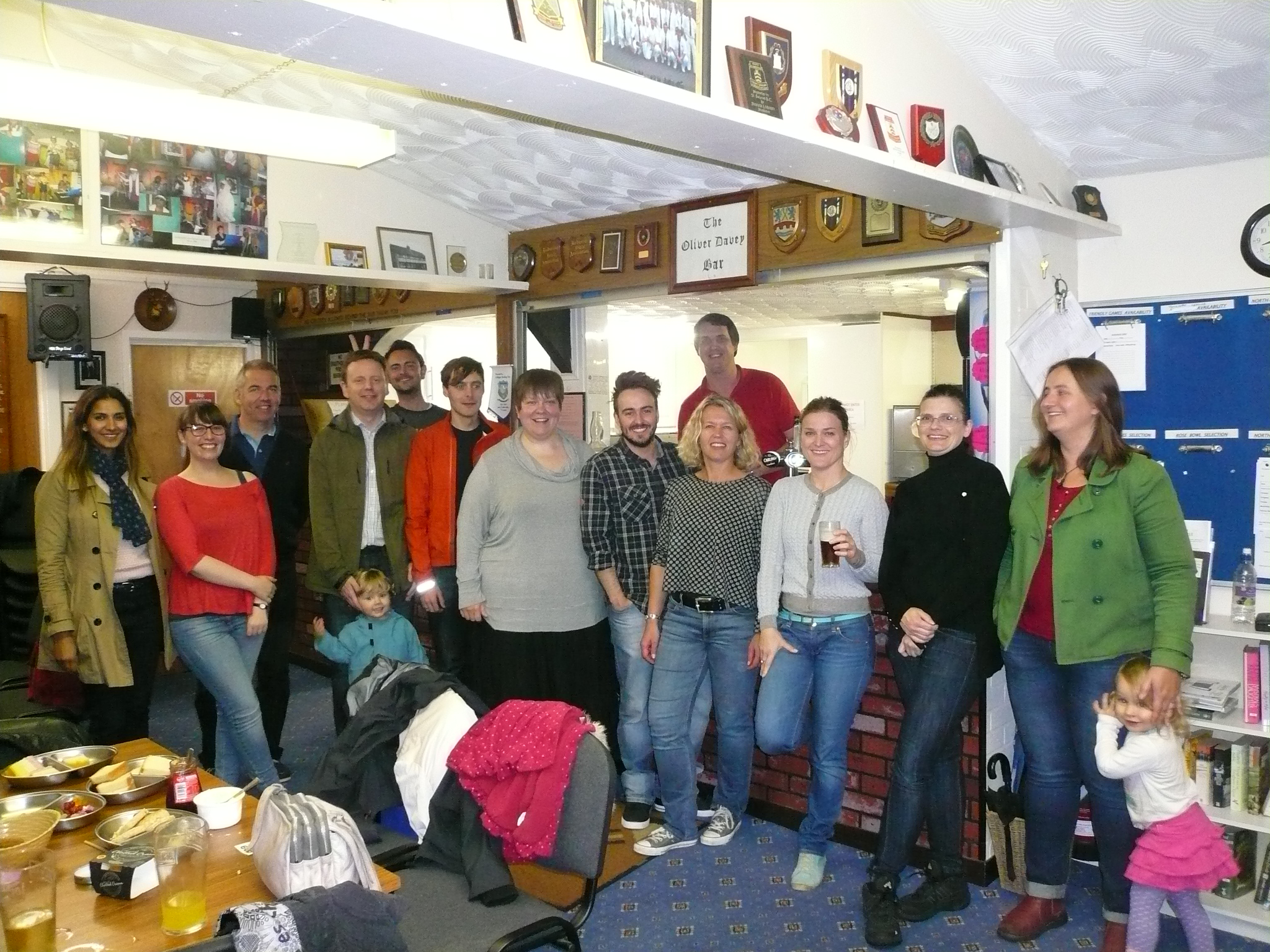
A group photo inside St. Fagan's Bowls Club
A group photo inside St. Fagan’s Bowls Club

Welcome to Gaunt Francis in Cardiff!

In the Welsh capital, Gaunt Francis Architects’ Cardiff office is still buzzing with the same life, creativity and inspiration as our main London practice. Cardiff is an absolutely stunning city. Multicultural and vibrant, yet still with a strong sense of its Welsh identity it’s an inspirational city to work in and at the GFA Cardiff office, we pretty much have the best views for miles around.

I joined the Cardiff office in May of this year as an administrative assistant and therefore, because I’m not an architect, I often have a lot of questions. These are often questions such as “what on earth is a balustrade?!”, or “how much milk do we have left?”, but working in this new and exciting industry has also inspired me to get thinking about concepts, ideas and theories I had never encountered before.

Rather than keep my head in the clouds all day, this blog exists to document the novel and interesting things I discover as I work, to voice my musings and wonderings about architecture, and to give a brief peep into the working life of the GFA Cardiff office.

Enjoy!